


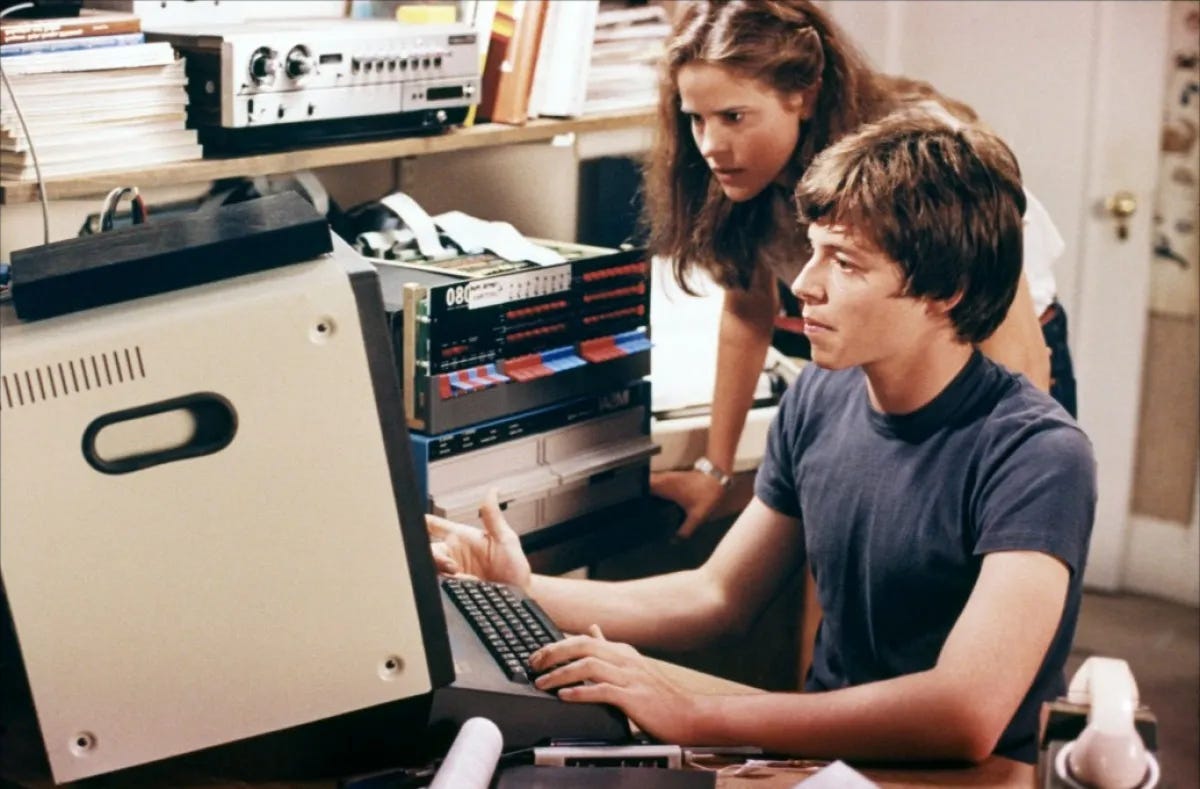
‘WAR GAMES’, 1983, frame from the movie
In the beginning, we couldn’t do much more than read.
Web1: creators have had their place on the Internet since the birth of the World Wide Web, but the users of the first hour were mostly not content producers. The production professionals, professional writers, reporters, and journalists, still belonged to the world of print and traditional media. The distribution model ran on a flow from the few to the many, and a large number of visitors accessed the web to read the information on static sites poured by academics and experimenters trying their hand at very rudimentary tools. When the big computer companies made publishing tools available to the big commercial companies, a media concentration was immediately created. At the height of this infantile - and perhaps still very naive - the era of the web, the scenario presented on the one hand the publisher sitting on the throne of intermediation to determine what was correct to publish, and on the other hand an increasingly nonchalant public in its online behavior inspired by the first primitive experiments in social networking, demanding maximum openness about content. From this contrast emerged the point of the ethical issue that had not emerged before censorship. Some forty years after that story, Web1-like websites still exist today, buried under gigantic mountains of pages, mostly produced by Prosumers: producers-consumers of content.
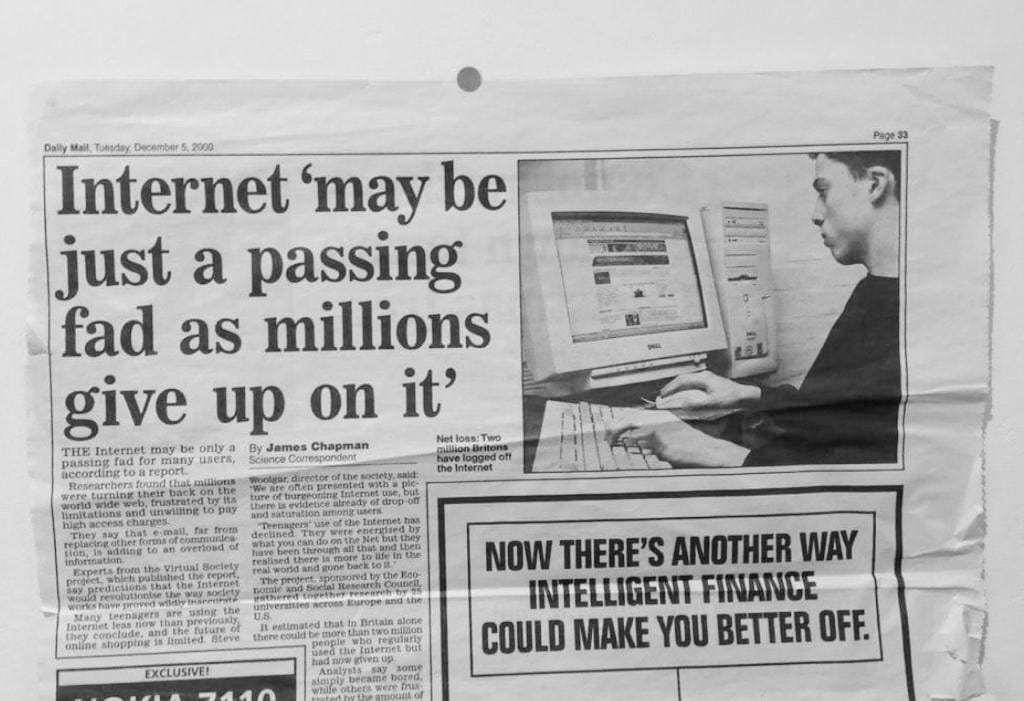
‘INTERNET MAY BE PASSING’, 2000, an article from Daily Mail newspaper
Then the Prosumer age came: the keyword is Web2, or the Web as we know it today. It took off in the early 2000s. Coined by Tim O'Reilly, Web2 was triggered by improvements in servers, developer capabilities, and Internet speed that paved the way for interactive Web applications. Some attribute the start to the aftermath of the dot-com boom. Although many companies dominate Web2, there are a few giants that are familiar to us: Google, Microsoft, Apple, Amazon, and Facebook. At its core, Web2 has given everyone the opportunity to become a prosumer: to create and consume content simultaneously. Although not everyone earns from what they create. Users produce media on social networks that they are then able to sell and make impressive amounts of money from. This is perfectly permissible, as centralized companies own user data and all user-created content. Censorship has found a new dimension to express itself in Web2, directly linked to the management of the user experience that evolved when websites became platforms: although users are both providers and consumers, to meet in the place where they create and consume content they give up any ownership rights. Web2 is the adolescent age of the Internet, where ambiguity in the way freedom of expression is handled by networks leads to huge contradictions in ethical, social, and political terms. At this stage, the scenario is characterized by three fundamental points: (1) Privacy is a big issue, as intermediaries are responsible for protecting users' data - our data. (2) Capital accumulates exponentially at the top; if everyone produces content freely and everyone uses it freely, the real product is no longer the content, but the users themselves who consume and produce it. The enormous amount of content exchanged every hour and every day of the year, in every time zone of the world by billions of users, is the engine of an economy of values that would not be exponential in themselves, if they were not so accelerated: the values of the digital experience. Unfortunately, these values are only capitalized by a few platforms, relegating users to the role of commodities. (3) The interest of platforms in containing the user base in their own manned enclosures to administer their private data has built an archipelago of incommunicable containers of experience: users have to create an identity on each platform in order to interact, as platforms do not 'talk' to each other.
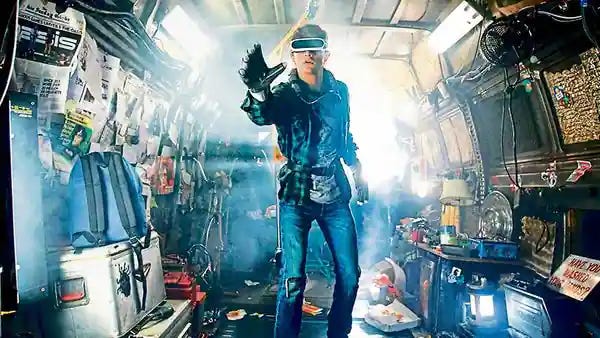
‘GET READY PLAYER ONE’, 2018, frame from the movie
And now we are opening new kinds of doors: enter Web3.
We are taking our first steps into the adult age of the Web. Ownership is one of the most important features of Web3 - where technologies provide a decentralized means to define ownership of an asset: be it content, data, or physical goods. The financial network based on Bitcoin blockchain technology was launched in 2009, proposing itself as a form of alternative and counter-institutional economic ethics that Web3, in its fullest and most complete vision should embrace. It is important to note that the Internet has not yet reached what we call Web3, but products and services are being developed that are considered Web3 that is absolutely different from previous generations because they basically get rid of all forms of intermediation on any kind of transaction in which the social organism is involved: not only financial but also informational and political. The Web3 scenario announces itself as (1) open, (2) decentralized, (3) censorship-resistant, (4) immutable, (5)without fiduciary intermediation, and (6) permissionless.
As the transition from Web1 to Web2, the transition from Web2 to Web3 is largely due to the evolution of the infrastructure, but there will be a change of mindset among builders and developers as management will be much more user-centric. Since there is no longer an intermediary and the data lives on immutable infrastructure, there is no control over the data and therefore no censorship and less risk of data loss.
Interoperability is an important issue for blockchains, as it is for platforms built on the Web3. Through integration to one's cryptocurrency wallet, the user accesses different platforms that offer different experiences but are connected in a fluid space where a person's identity and social credit - i.e. their wealth of online relationships - remains expendable wherever it is taken: meaning that not only is there no need to create an account on different platforms, but what the user produces and consumes can be capitalized on in each of them regardless of how and where it was created.
This is why the immersivity of the Metaverse is the ideal form of Context with which to express the principles of the Web3: because the Metaverse can host any form of interactive experience and thus be the place where any form of exchange takes place; where any form of content can be expressed. We can therefore say that Web3 represents the ideal Protocol of the Metaverse: if the user's perception of the Metaverse is provided by the Web2 infrastructures that create experiences that are (1) Persistent, (2) Synchronous, (3) Arbitrarily Explorable and finally (4) Immersive: it is thanks to Web3 that the Metaverse overcomes the limits of the pre-existing super-powers of the Web, becoming (4) Decentralised - with the model of DAO autonomous organizations and (5) Tokenized - with the model of crypto-currencies.
The Web3 has all the necessary technology to give users, all individual users, the original ownership on their identity back, in every respect, and doing so gives shape to a new generation of political dynamics at the macro scale. Web3 enables a kind of exponential growth that is no longer centralized as in the past, making clear the need for new approaches to balance the forces between those who originate the production of value - the user - and those who enable that production - the platforms.